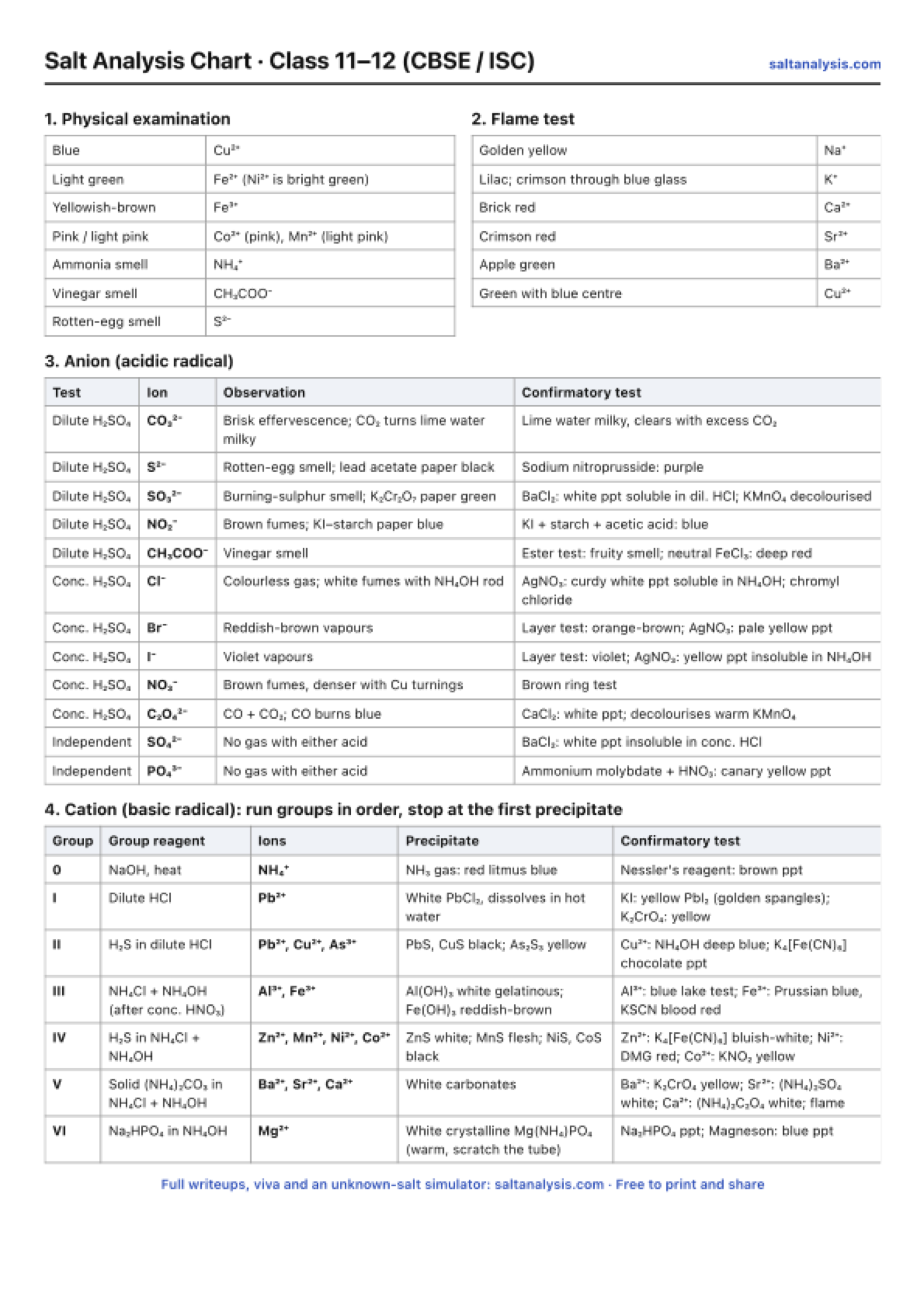
Salt analysis chart The whole Class 12 scheme on one A4 page: anion tests, cation groups 0 to VI, group reagents, precipitate colours, confirmatory tests and flame colours.
Send to your lab group Copy link
Salt Analysis Chart · Class 11–12 (CBSE / ISC) saltanalysis.com 1. Physical examination Blue Cu²⁺ Light green Fe²⁺ (Ni²⁺ is bright green) Yellowish-brown Fe³⁺ Pink / light pink Co²⁺ (pink), Mn²⁺ (light pink) Ammonia smell NH₄⁺ Vinegar smell CH₃COO⁻ Rotten-egg smell S²⁻
2. Flame test Golden yellow Na⁺ Lilac; crimson through blue glass K⁺ Brick red Ca²⁺ Crimson red Sr²⁺ Apple green Ba²⁺ Green with blue centre Cu²⁺
3. Anion (acidic radical) Test Ion Observation Confirmatory test Dilute H₂SO₄ CO₃²⁻ Brisk effervescence; CO₂ turns lime water milky Lime water milky, clears with excess CO₂ Dilute H₂SO₄ S²⁻ Rotten-egg smell; lead acetate paper black Sodium nitroprusside: purple Dilute H₂SO₄ SO₃²⁻ Burning-sulphur smell; K₂Cr₂O₇ paper green BaCl₂: white ppt soluble in dil. HCl; KMnO₄ decolourised Dilute H₂SO₄ NO₂⁻ Brown fumes; KI–starch paper blue KI + starch + acetic acid: blue Dilute H₂SO₄ CH₃COO⁻ Vinegar smell Ester test: fruity smell; neutral FeCl₃: deep red Conc. H₂SO₄ Cl⁻ Colourless gas; white fumes with NH₄OH rod AgNO₃: curdy white ppt soluble in NH₄OH; chromyl chloride Conc. H₂SO₄ Br⁻ Reddish-brown vapours Layer test: orange-brown; AgNO₃: pale yellow ppt Conc. H₂SO₄ I⁻ Violet vapours Layer test: violet; AgNO₃: yellow ppt insoluble in NH₄OH Conc. H₂SO₄ NO₃⁻ Brown fumes, denser with Cu turnings Brown ring test Conc. H₂SO₄ C₂O₄²⁻ CO + CO₂; CO burns blue CaCl₂: white ppt; decolourises warm KMnO₄ Independent SO₄²⁻ No gas with either acid BaCl₂: white ppt insoluble in conc. HCl Independent PO₄³⁻ No gas with either acid Ammonium molybdate + HNO₃: canary yellow ppt
4. Cation (basic radical): run groups in order, stop at the first precipitate Group Group reagent Ions Precipitate Confirmatory test 0 NaOH, heat NH₄⁺ NH₃ gas: red litmus blue Nessler's reagent: brown ppt I Dilute HCl Pb²⁺ White PbCl₂, dissolves in hot water KI: yellow PbI₂ (golden spangles); K₂CrO₄: yellow II H₂S in dilute HCl Pb²⁺, Cu²⁺, As³⁺ PbS, CuS black; As₂S₃ yellow Cu²⁺: NH₄OH deep blue; K₄[Fe(CN)₆] chocolate ppt III NH₄Cl + NH₄OH (after conc. HNO₃) Al³⁺, Fe³⁺ Al(OH)₃ white gelatinous; Fe(OH)₃ reddish-brown Al³⁺: blue lake test; Fe³⁺: Prussian blue, KSCN blood red IV H₂S in NH₄Cl + NH₄OH Zn²⁺, Mn²⁺, Ni²⁺, Co²⁺ ZnS white; MnS flesh; NiS, CoS black Zn²⁺: K₄[Fe(CN)₆] bluish-white; Ni²⁺: DMG red; Co²⁺: KNO₂ yellow V Solid (NH₄)₂CO₃ in NH₄Cl + NH₄OH Ba²⁺, Sr²⁺, Ca²⁺ White carbonates Ba²⁺: K₂CrO₄ yellow; Sr²⁺: (NH₄)₂SO₄ white; Ca²⁺: (NH₄)₂C₂O₄ white; flame VI Na₂HPO₄ in NH₄OH Mg²⁺ White crystalline Mg(NH₄)PO₄ (warm, scratch the tube) Na₂HPO₄ ppt; Magneson: blue ppt
Use it with the full writeups The chart is the short version. For the practical file you need the full Experiment–Observation–Inference table of your salt: open it from the salt list , revise reagents on the group pages , look up any test on the named tests list, and practise on a random salt in Exam Mode .